Six years after his accession, Sultan Haitham bin Tariq has consolidated his power on the domestic front in Oman. The sultanate, however, has been weakened on the international stage by the consequences of the war between the United States and Iran. Whilst it remains the guardian of the southern shore of the Strait of Hormuz, it is held hostage by Iran, which has closed the strait and will only consider reopening it on its own terms. In the meantime, Washington and Tehran are putting pressure on Muscat to ensure that Oman supports their conflicting demands. This belligerent context offers the sultanate opportunities for economic diversification in the fields of connectivity and maritime affairs, particularly at the Doqum hub. The Omani government is, however, taking great care not to cause too much friction with Iran and the United Arab Emirates, which are its two most difficult neighbours to manage. It remains firmly committed to its two core principles: on the one hand, an active and neutral diplomatic approach aimed at promoting regional stability by continuing to act as a reliable intermediary, even though the emerging Iranian hegemony is making this balanced stance more difficult to maintain; on the other hand, a benevolent yet strict control over the population, to secure social peace and promote an image of tolerance towards minorities (including religious ones), all of which are levers that could be exploited by potential adversaries of the Omani monarchy.
The Sultanate of Oman has long maintained the discretion befitting states that act as mediators on the international stage. Attention is only drawn to them during regional crises or during rare periods of domestic uncertainty[1]. This was the case in January 2020 following the death of Sultan Qaboos, who died without an heir after a reign spanning half a century[2]. His successor and cousin, Haitham bin Tariq, has since consolidated his power by reinforcing an inclusive approach. Following Donald Trump’s re-election to the White House, he became involved in discreet negotiations between Iran and the United States, just as his predecessor had done during Barack Obama’s first term – a process that had led to the JCPOA nuclear agreement (2015). In June 2025, these high-profile negotiations were interrupted by the Twelve-Day War launched by Israel against Iran. They were revived following the outbreak of the war between the United States and Iran on 28 February 2026. Sultan Haitham continues to enjoy the confidence of both Tehran and Washington, even though the Iranian regime has not hesitated to target the American presence on its territory[3] as well as Omani economic interests, and even though the White House has verbally lashed out at Oman, repeatedly threatening to bomb the sultanate if it played into Iran’s hands[4]. Whilst the Iranian threat is implicitly accepted, the US president’s aggressive statements have caused deep unease in Muscat, as the FMES observed during a fact-finding mission carried out there from 5 to 10 July 2026. Since the signing of a memorandum of understanding between Washington and Tehran (17 June 2026), Oman has been forced to negotiate the future status of the Strait of Hormuz under pressure from Iran, whilst the White House is stepping up pressure to persuade the Omani authorities to align with its position.
The Strait of Hormuz at the heart of the standoff between the United States and Iran
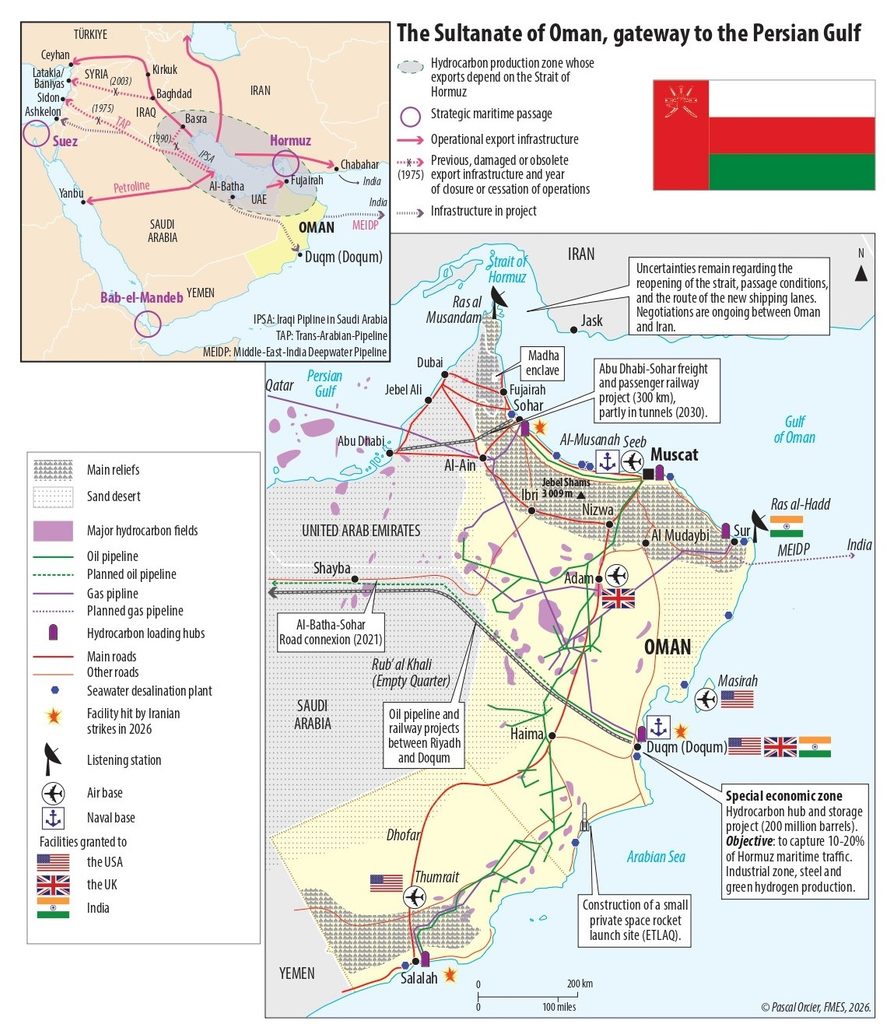
The Sultanate of Oman remains, in theory, the guardian of the southern shore of the Strait of Hormuz, as it controls Cape Ras al-Musandam (see map) and virtually the entire shipping lane leading into and out of the Persian Gulf. Tehran is exerting very strong pressure on Muscat to establish an Iranian-Omani condominium controlling the Strait, thereby denying the principle of free passage enshrined in international law and imposing a toll on all vessels passing through it. This joint administration also aims to impose a new maritime route through the Strait, close to their coastline, which would allow the Iranians to inspect vessels they deem suspicious and to prohibit, by force if necessary, the passage of vessels deemed hostile, particularly those linked to American and Israeli interests. The United States, for its part, insists on upholding the principle of free passage and that it remains free of charge. They state that they stand ready to continue imposing the naval blockade of Iranian ports for as long as they deem necessary.
The Omanis therefore find themselves caught between two fires. On the one hand, they feel vulnerable to Tehran, which has shown that it will not hesitate to strike at those who resist it. On the other hand, they wish to be seen as respecting international law and reject the principle of a toll. They know that their image is at stake, a crucial element of their soft power. The Omanis are trying to carve out some room for manoeuvre in the face of American and Iranian pressure, and to come up with original ideas to extricate themselves from this difficult situation. One such idea is to set up a ‘maritime Davos’ in Oman as a forum for exchange and discussion involving the International Maritime Organisation (IMO), with the first event scheduled to take place in late October 2026. In the meantime, they are continuing technical discussions to reach an agreement with Iran on the route of a new maritime corridor that would pass through Iranian territorial waters on the incoming path and Omani territorial waters on the outgoing path, in order to assert both countries’ effective sovereignty over the Strait of Hormuz[5].
A stable domestic situation
After six years in power, Sultan Haitham (aged 70) has taken up his cousin’s legacy and consolidated his power. The rules of succession have been clarified and his eldest son, Prince Theyazin (aged 36), has been appointed Crown Prince. The situation is stable; the population, modest and thrifty, is content with the welfare state, and the Sultan takes great care to maintain an inclusive system in which all minorities and tribes are well represented and benefit from sufficient economic and political advantages to secure their allegiance. The Dhofaris and the Shia are thus represented in many key posts.
The security situation is under control. The Dhofar rebellion is now nothing more than a distant memory, and the riots of 2011 have not recurred. As an aside, a law prohibits causing a disturbance in public places, designed not only to ban violent demonstrations but also to combat anti-social behaviour[6]. Omanis are very aware of the Islamist terrorist threat from Al-Qaeda in Yemen (the last attack took place in 2024), which they monitor very closely. Unlike in the United Arab Emirates (UAE), the Muslim Brotherhood is not perceived as a threat in the country, but it remains under close surveillance. Internal security falls under the remit of General Saïd Ben Zahir Al-Hilali, head of the intelligence services. The Minister of the Interior, for his part, is concerned solely with ‘social peace’, managing financial redistribution and relations with the tribes. The press is tightly controlled and social media is closely monitored, but access to foreign websites is not censored. The royal court, deeply committed to upholding Omani traditions and culture[7], seeks to promote an image of tolerance towards religious minorities – the majority of the population are Ibadite Muslims[8] – which are all potential levers that external actors wishing to weaken the Omani monarchy could exploit. Traditional Sunni influence is thus on the rise, encouraged by Saudi Arabia and the UAE. Shia influence is also growing, as evidenced by the decision of many Iranian and Pakistani Shias to settle in Oman after being expelled from the UAE following Iranian strikes on the Emirates. Iranian banks are opening branches in Oman.
In terms of security, the 12 seawater desalination plants remain highly vulnerable critical infrastructure, easy to target, as the FMES team observed. They produce 1.5 million cubic metres of fresh water daily, supplying 90 per cent of the country’s consumption[9]. Their number, however, ensures a degree of redundancy. The same applies to the thermal power stations that supply the electricity essential to the country’s functioning and power the air-conditioning systems, without which life here would be unbearable for part of the year.
Economic diversification centred on the Duqm hub
The economic situation is far better than it was six years ago, when the former Sultan Qaboos, now elderly and frail, allowed the deficit to spiral out of control. Today, the public deficit has been reduced to 35 per cent of GDP thanks to a highly orthodox fiscal policy and dynamic economic liberalisation. Although oil and gas production (1 million barrels per day and 50 billion m³ per year) still accounts for 30 per cent of GDP and 70 per cent of budget revenue, hydrocarbon reserves are dwindling. Oman has therefore embarked on a strategy of economic diversification, focusing on logistics transhipment to circumvent blockades of the Straits of Hormuz and Bab el-Mandeb via its ports at Duqm (to Saudi Arabia and East Africa) and Sohar (to the UAE and the Persian Gulf). The Sultanate is also focusing on tourism, with a clear aim to attract some of the tourists – particularly Russian-speaking visitors – who are turning away from the UAE and Qatar, as well as on services and property, green energy (solar power and green hydrogen), steel production and certain mineral resources (gypsum, chalk and silica).
The Omani authorities are also seeking to attract data centres and high-tech companies, as evidenced by the rise of the Omani start-up ETLAQ, which has embarked on the construction of a ‘spaceport’ for launching small rockets from a site ideally situated south of Duqm, overlooking the Indian Ocean, allowing for eastward launches (which are easier given the Earth’s rotation) and situated closer to the Equator than many competing sites. Given the planned payload (400 kg) for these rockets, the aim will be to place constellations of small satellites into orbit for private companies.
Against this rather favourable economic backdrop, the population[10] has just one major expectation: the creation of well-paid jobs for young Omanis, given their unemployment rate of over 35 per cent. The Sultan’s main challenge is therefore to get Omanis into work and to create enough jobs. This is already the case in the civil service, the police and the army, but the system appears to have reached its limits. The aim now is to persuade more private companies to employ a growing proportion of Omani staff, whose adaptability in the workplace is a subject of debate amongst foreign investors. The sovereign wealth fund (OIA) is seeking to improve the management practices of state-owned enterprises in order to attract them.
The closure of the Strait of Hormuz and the ongoing risks in the Bab el-Mandeb Strait have boosted demand for maritime[11] and logistics services, benefiting the port of Duqm, which is establishing itself as Oman’s major economic development hub. The port is ideally situated in deep water with direct access to the Indian Ocean, far from both straits, although it remains within range of Iranian missiles and drones. The Duqm region lies at the heart of the Sultanate’s economic diversification, as the Omani authorities aim to turn it into:
- An alternative connectivity hub capable of capturing 10 to 20 per cent of the maritime traffic passing through the Strait of Hormuz, particularly that bound for the UAE (Jebel Ali and Fujairah). The Omanis are not aiming any higher, so that Doqum is not perceived as an economic threat by Abu Dhabi, but above all by Iran, which seeks to force shipping operators to pass through the Strait of Hormuz.
- An energy production centre (natural gas liquefaction, refinery, oil exports) and industrial hub (steel production, mining).
- A ‘safe haven’ for storing large quantities of hydrocarbons (200 million barrels of oil) and steel on site, in the event of a global shortage.
- A cost-effective green energy production centre aiming for a cost of $3.25 per kilogramme of hydrogen, powered by electricity generated locally, notably by vast wind and solar farms.
- A hub to supply Saudi Arabia securely via road (existing), pipeline (under construction) and rail (to be built).
- Military facilities for friendly nations, although during the recent war, Oman took great care not to appear as a US or Western base. France would undoubtedly benefit from increasing its naval and air stopovers at Duqm, a base ideally situated between Djibouti and Abu Dhabi.
The Omani government is seeking both to attract foreign investors to Duqm, which retains its status as a free zone, and to ensure that no single investor holds a majority stake or dominates its competitors. At present, the main investors, apart from the Sultanate itself, are from the US, Europe (primarily the UK, Belgium and the Netherlands) and Asia (notably India, South Korea and Japan). China is attempting to establish a presence in Duqm, but its investments are being closely scrutinised by the United States, which is largely blocking them. The Omanis have offered the Emirati consortium DP World a 5 per cent stake in Duqm, on condition that it uses the infrastructure on a permanent basis and not just in times of crisis, as is currently the case.
In terms of connectivity, only the gas fields located in the far south of the UAE are connected to the Omani network, which extends northwards to Sohar, Muscat and Sur, and southwards to Duqm and Salalah. For the overland transport of containers, Oman and Abu Dhabi have agreed to build a railway line linking Sohar to the Emirati network, passing beneath the mountains that form a natural border between the two states. Although it is not a party to the initiative due to Israel’s involvement, Oman is showing great interest in the IMEC (India/Middle East/Europe Corridor) initiative, promoted by India, the UAE, France and Italy, as an alternative route to the one intended to pass through the Emirates.
The most ambitious projects aim to link the Duqm hub in eastern Saudi Arabia via a road built in the middle of the sandy desert to the north of what the Saudis call the ‘Empty Quarter’ of their kingdom, an oil pipeline and a railway line intended to follow roughly the same route (see map). The road already exists but needs to be widened and upgraded. The oil pipeline is reportedly under construction. The railway is still only at the planning stage, but feasibility studies have been carried out. It is likely that the twin crises in the Strait of Hormuz and the Strait of Bab el-Mandeb will persuade the Saudi and Omani authorities to speed up the work.
A foreign policy still based on balance and neutrality
The foundation of Omani foreign policy remains the promotion of neutrality, non-alignment and diplomacy as the main levers of influence. Oman remains a member of the Gulf Cooperation Council. Foreign Minister Badr bin Ahmad Al-Busaidi remains one of the most influential figures in the sultanate.
- With Iran: Relations remain close and characterised by a degree of trust, even though the Omanis are aware of the threat posed to them by a highly assertive and at times brutal Iranian regime. They are largely convinced that the Iranians will emerge victorious from the current situation, even though it is not yet over. They accept that Iran could become the new hegemon in the Gulf, even if they reject this term in public. Above all, they know they must act pragmatically, as the Iranians will remain their neighbours, will not hesitate to strike at them, and will retain a position of strength over the Strait of Hormuz.
- With the United States: Omanis harbour strong resentment towards the Trump administration, which has directly threatened them – a first in the history of their bilateral relationship. The Memorandum of Understanding (MOU) between the United States and Iran, which is highly favourable to Iranian interests, has been seen as signalling ‘the break-up between the United States and its allies in the Middle East’[12]. The prevailing view is that the United States has lost credibility in the region. The Omanis are determined to reassess the role and function (but not the presence) of the military facilities provided to the United States on their territory to ensure that they are not perceived as a direct threat by Iran. They are, however, aware that they need the US armed forces to protect themselves and curb Iran’s ambitions regarding the Strait of Hormuz. They have realised that the United States has a strategic interest in remaining on Omani soil to operate effectively in the Strait of Hormuz, whilst the Pentagon could withdraw from other states in the region without jeopardising its Middle Eastern strategy. Oman remains, in fact, a formidable bridgehead for deploying US (and Western) troops to the region from the Indian Ocean, notably thanks to the Duqm hub.
- With the United Kingdom: The former British colonial power remains very much present and influential in the sultanate, across all areas[13]. However, British meddling irritates the sultan, as evidenced by the expulsion of an ambassador accused of interfering in Omani internal affairs; the credentials of the following ambassador were only accepted after a year. Furthermore, the United Kingdom is perceived as weakened militarily, diplomatically and politically, which appears to diminish its appeal in the eyes of the Omanis.
- With India: India, which has had a significant economic and human presence in Oman for centuries, remains a key partner of the sultanate. Indians constitute the largest and best-integrated foreign minority. India has naval facilities at Duqm and a listening station at Sur. Relations between Sultan Haitham and Narendra Modi are very good.
- With Pakistan: Oman also maintains good relations with Pakistan, based on a policy of balancing its ties between New Delhi and Islamabad. Many Shia Pakistanis have settled in Oman. The strategic rapprochement between Saudi Arabia, Turkey and Pakistan reinforces the value of ongoing dialogue between Muscat and Islamabad, as does the Pakistani regime’s role as a mediator between Washington and Tehran.
- With China: By the Omani officials’ own admission, it is the ‘principle of strategic mistrust but economic pragmatism’ that prevails. The Omanis seem convinced that China will not replace the United States as the provider of security in the region. The Chinese, however, remain indispensable in economic and energy terms. This is why they are reportedly seeking to secure a logistics base on the Omani coast, halfway between their bases in Djibouti and Gwadar (Pakistan).
- With Russia: There is evidence of growing Russian and Belarusian investment in the Omani property market, raising strong suspicions of money laundering. Furthermore, ships from the Russian ‘ghost fleet’ fly the Omani flag. The Russians are developing cultural cooperation with Oman and are preparing to open a branch of the Hermitage Museum in Salalah. Oman is seen as a new tourist destination for Russians and Belarusians, who are no longer welcome in the UAE. However, no military cooperation is officially envisaged between Oman and Russia, even though the Crown Prince was received by Vladimir Putin at the Kremlin (7 December 2023) and the Sultan made a state visit to Moscow (21–22 April 2025), perhaps to lay the groundwork for future Russian-Omani relations.
- With Saudi Arabia: Relations have now improved and there are significant economic prospects, particularly in connection with Duqm. Many Omanis are convinced of the need to forge a more inclusive regional security framework, one that is more firmly led by key players in the Middle East. They view with interest the initiatives promoted by Saudi Arabia, Pakistan and Turkey, believing that, in the interests of balance, these could be extended to include Egypt and Iran. Omanis fear, however, that the Saudis may seek to regain the upper hand in Yemen against the Houthis, thereby reigniting a conflict that would destabilise the border between Yemen and Oman – a grey area currently held by the Omani ‘Tribal Force’. The Omanis do, in fact, maintain good relations with the Houthis, who have a representative office in Muscat. Negotiations between the United States, Saudi Arabia and the Houthis very often take place in Oman. This is likely to be the case once again.
- With the United Arab Emirates: It is, in fact, with the UAE that relations remain the most complex. Within the GCC, the Omanis criticise their Emirati neighbours for their stance on Yemen and Sudan, their provocative attitude towards Iran and their strongly pro-Israeli stance, with Israel being accused of sowing chaos in the region. They also highlight the UAE’s attempts to interfere in Oman’s internal affairs (notably in 2011 and 2020) and point to the dual economic rivalry between the seaports of Jebel Ali and Duqm, and between Fujairah and Sohar. The two states are nevertheless bound to find common ground given their history, geography and economy. Oman has two enclaves within the UAE: Madha[14] and Cape Ras al-Musandam. The UAE remains the Sultanate’s leading trading partner, excluding hydrocarbons.
Oman–France: a promising rapprochement raising high expectations
Paris rolled out the red carpet for Sultan Haitham during his first official visit to France on 29–30 June 2026, during which major economic and industrial agreements were signed, notably with Suez and CMA-CGM[15]. This visit can be interpreted as an outstretched hand towards France, a sign of irritation towards the United States and the United Kingdom (the sultanate’s two historically most influential partners), and a means of cleverly re-engaging with the Europeans via Paris.
France is perceived as a neighbour of Oman due to its presence in the Indian Ocean. The Omanis welcome the French presence on La Réunion and have never caused Paris any difficulty over the sensitive issue of Mayotte. They appreciate France’s friendly, frank and balanced attitude, as well as its non-involvement in the ongoing conflict between the United States and Iran, and its commitment to international law and freedom of navigation.
That said, the Omanis remain very reluctant towards the proposed maritime security mission in the Strait of Hormuz, championed by France and the United Kingdom, which is causing irritation in Tehran. Aware of their vulnerability in the face of an unchecked Iran, they do not wish to give the impression of endorsing a Western military operation perceived as hostile to Iran. The best option for them would be for this mission to be shelved.
Today, Franco-Omani cooperation rests on two pillars: firstly, a promising economic and industrial dimension[16], underpinned by the presence of Veolia, Suez, Total, Air Liquide, Thales, Saint-Gobain, Orange, Engie and, more recently, CMA-CGM. Secondly, a dynamic military dimension based on high-level exchanges and dialogue (two visits by the French Chief of the Defence Staff in less than a year), training, officer exchanges and cooperation with the Defence Academy and the National Defence College. In the field of armaments, the most recent deliveries of major equipment (NH-90 helicopters, artillery, light armoured vehicles, radars) date back around ten years. In light of the ongoing confrontation in the Strait of Hormuz, the Omanis’ top priority is to acquire anti-drone and anti-missile capabilities. They do not wish to acquire any systems perceived as being too ‘offensive’. Indeed, they would be prepared to sell their fleet of Typhoon fighters to Turkey, whilst retaining their fleet of latest-generation F-16s for the air defence of their territory. The acquisition of Rafale aircraft or sixth-generation fighters is therefore not on the agenda. From Oman’s perspective, the only point of friction in bilateral relations concerns France’s very strong military support and assistance to the UAE, which are perceived as difficult neighbours.
Given this promising context, there are high expectations that France will follow through on its announcement to strengthen this bilateral relationship, both economically and diplomatically. The Omani authorities are therefore hoping for a ‘return visit’ by President Emmanuel Macron to Muscat before the end of his term in office.
The Omani Armed Forces comprise 57,000 personnel, 4 brigades and 4 regiments, 110 tanks (Challenger 2 & M-60A/3), 47 combat aircraft (Typhoon, F-16 Block-50 & Hawk Mk-203) and 3 frigates (Al-Shamikh)[17]. They are motivated, well-trained and wholly devoted to the Sultan. They serve as a source of employment to reduce youth unemployment. Focused exclusively on the defence of the territory, they possess no real offensive capability. The country’s size affords them strategic depth, which would enable them to trade territory for time in case of foreign aggression. Their tribal militias ensure highly effective territorial control, particularly in the southern province of Dhofar. Their main vulnerability lies in their lack of access-denial capabilities: severely inadequate anti-aircraft systems, no anti-drone systems, no coastal defences and no anti-submarine warfare capability.
* * *
To conclude, and given its direct access to the Indian Ocean, Oman has a historic window of opportunity to play a major role in maritime and energy transhipment to and from the Arabian Peninsula. The Omanis are aware of this, but the Iranian threat is such that they are reluctant to capitalise on this opportunity too openly. France might perhaps assist them in this regard: by helping them to identify opportunities; economically, through tailored partnerships; and diplomatically, by facilitating international acceptance of the Sultanate’s role. Oman remains, indeed, deeply committed to an active and neutral diplomatic approach aimed at promoting regional stability whilst continuing to act as a reliable intermediary. It is highly unlikely that the Sultanate will change course in the foreseeable future, whatever the outcome of the ongoing war between the United States and Iran. As the Omani authorities maintain close relations with both belligerents, they will always be able to engage in dialogue with whichever side emerges victorious, without severing ties with the other. The longer the blockade of the Strait of Hormuz continues, the more Oman will appear as an attractive alternative for a growing number of maritime stakeholders.
P.R.
[1] Marion Sorant, « Oman toujours au cœur des recompositions régionales », FMES, December 2023 : https://fmes-france.org/oman-toujours-au-coeur-des-recompositions-regionales/
[2] Chloé Jamet, « Perspectives stratégiques du Sultanat d’Oman post-Qabous », FMES, November 2021 : https://fmes-france.org/perspectives-strategiques-du-sultanat-doman-post-qabous/
[3] On 1 and 3 March 2026, several Iranian drones struck US interests in the port of Duqm, in southern Oman. On 11 and 28 March, the port of Salalah, in the far south of Oman, was also targeted by Iranian drones. On 13 March, the port of Sohar, in the north of the sultanate, was in turn targeted. Similarly, several dozen oil tankers were attacked whilst sailing through the Strait of Hormuz within Omani waters. All these attacks took place far from the capital, probably to spare the sultan. In early July, several Iranian drone strikes once again targeted US interests in the port of Duqm in retaliation for further US strikes against Iran.
[4] Donald Trump’s statements on 27 May and 17 August 2026 : https://www.theguardian.com/us-news/2026/may/28/first-thing-trump-threatens-oman-strait-of-hormuz ; https://www.theguardian.com/world/2026/aug/17/donald-trump-threatens-bomb-oman
[5] « L’Iran dit avoir trouvé un accord avec Oman sur un nouveau tracé dans le détroit d’Ormuz », Le Monde avec AFP, 5 August 2026.
[6] In the view of both citizens and expatriates, this law does indeed provide an effective means of tackling anti-social behaviour. Any offender, even if acting within their rights, risks a substantial fine and a trip to the police station.
[7] A law thus prohibits the construction of buildings taller than 10 floors.
[8] Ibadism is regarded as the fifth school of Sunni Islam and traditionally focuses on adherence to Islamic principles, education, work and equality amongst the various Koranic schools. Long marginalised, it holds that the Commander of the Faithful need not necessarily be a descendant of Muhammad, which distinguishes it from Shi’ism.
[9] Veolia operates Oman’s three largest seawater desalination plants, which account for 30 per cent of freshwater production. The other desalination plants are managed by Spanish, German, American, South Korean and Chinese companies.
[10] Of the 5.3 million inhabitants of the Sultanate of Oman, 53 per cent are nationals and 47 per cent are expatriates – a much more balanced proportion than in the other Gulf monarchies.
[11] The Omani shipping group ASYAD has seen its business and revenue grow by 30 per cent since the start of the war between the United States and Iran. It is seeking to establish itself as a key regional player in maritime trade, notably through agreements with major European (Maersk and CMA-CGM) and Asian shipping companies, and aims to join the world’s top 10 shipping companies.
[12] As a renowned Omani expert told the FMES team during his visit to Muscat.
[13] 90 British nationals are serving in the Omani armed forces.
[14] The Omani enclave of Madha itself contains a mini-enclave belonging to the UAE (the village of Nahwa).
[15] Suez has secured a fifteen-year, $2 billion contract for the supply of fresh water and the treatment of wastewater; CMA-CGM has announced its intention to invest $400 million in the port of Sohar, in the north of the sultanate, to unload containers there which will then be transported by road and rail to the UAE.
[16] The trade balance, at around 410 million euros (2025–26), is slightly in France’s favour.
[17] Updated data taken from The Strategic Atlas of the Mediterranean and the Middle East, FMES, 2024.