Air-to-ground combat
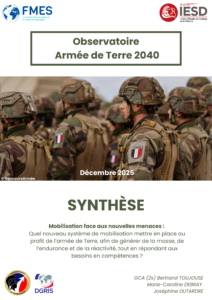
- Army 2040 Observatory
The Chief of Staff of the French Army (CEMAT) emphasized the critical importance of adapting the Army to a rapidly changing global environment. Extreme tensions in the Levant and the war in Ukraine illustrate a geostrategic turning point marked by the return of war, the uninhibited use of violence, challenges to our system of values and to international law, and accelerating technological change.
The Army has fully grasped the significance of this moment and has, over the past year, embarked on a profound transformation. Its objective is to be immediately ready to respond to any threat while continuing to innovate in order to prepare for the future.
Moreover, 2025 marks the second year of implementation of the 2024–2030 Military Programming Law, which provides for an increase of €3.3 billion for the Defence mission, bringing it to €50.5 billion excluding pensions. The French Army directly benefits from this increase. However, the context of significant domestic and international political instability could have two types of consequences for this budget in the short to medium term.
On the one hand, a budget reduction cannot be ruled out should the economic situation and French public finances require savings to be made, including within the defence mission (although this is not currently anticipated). On the other hand, Donald Trump is likely to push allies and partners to increase their defence spending to 3 or 4% of GDP.
The French Army’s capability development and human resources policies are entirely dependent on the budget allocated to it.
Objectives of the Observatory
What adaptations must the French Army undertake in order to meet the challenges of all kinds it will face by 2040? This is the question the French Army 2040 Observatory is intended to address. The initiative is led by the FMES Institute in partnership with IESD for the 2025–2028 period.
To carry out this forward-looking analysis, 2040 appears to be an appropriate horizon: sufficiently distant to allow for reflection free from current events and the constraints of capability planning, yet close enough to remain meaningful. It is therefore necessary to identify and shed light on the main variables on which the evolution of the “French Army system” depends.
Decision support for preparing the future
To provide the Chief of Staff of the French Army (CEMAT) and senior Army leadership with a comprehensive situational assessment of the evolution of conflict; to analyze the current organization of the French Army and compare it with other models in order to identify its strengths and weaknesses; and to formulate recommendations.
To feed strategic and forward-looking thinking on land warfare
To stimulate and enrich the French Army’s military thinking by strengthening ties with French and international research communities, in order to benefit from independent expertise on land warfare issues that are seldom addressed outside the institution. This also involves ensuring generational renewal by engaging young researchers.
To promote innovation
By identifying structuring and disruptive civilian and military technological innovations, accessible “high–low mix” solutions, and by observing the adaptive and reactive innovation methods of other armed forces, to select best practices and promising ideas in order to guide and accelerate innovation (both procedures and techniques) within the French Army.
To showcase French Army military thinking
To share the findings of studies across the armed forces, interministerial bodies, and allied partners, as well as within the civilian sector, particularly with industry stakeholders, elected officials, and influential individuals concerned with defense issues. The aim is to contribute to a clear and accurate understanding of land warfare challenges and future strategic stakes.
To strengthen our understanding of other armies
Allied, neutral, or hostile (potential or actual).
Productions

Quels défis liés au développement de systèmes autonomes sur le théâtre de combat aéroterrestre ?
Les systèmes autonomes couplés à l’intelligence artificielle transforment profondément le champ de bataille aéroterrestre. Drones armés, robots de combat, essaims collaboratifs : ces technologies modifient les équilibres stratégiques et posent de nouvelles questions éthiques. L’institut FMES revient dans une infographie sur les grands défis liés à cette transformation : doctrine