Marie de Vries, researcher at the FMES Institute
Summary
Israel’s recognition of Somaliland on December 26, 2025, marks a transition from episodic rivalries to a structured competition over the Red Sea’s security architecture. This diplomatic move provides Israel with vital strategic depth to counter Houthi threats and Iranian influence, though it simultaneously risks creating new frontline vulnerabilities. The recognition has solidified a “Berbera Axis” (Israel-UAE-Ethiopia) centered on port access and maritime monitoring, which is now directly countered by a « Mogadishu Axis » (Somalia-Turkey-Egypt-Saudi Arabia) defending Somali sovereignty. Today, regional stability and Somalia’s formal sovereignty appear to outweigh the strategic advantages of diplomatic recognition. The near-term future of the territory will likely be defined not by a cascade of diplomatic breakthroughs, but by a phase of « calibrated ambiguity”. In this environment, practical influence, maritime access, and security cooperation will carry far more weight than formal declarations of statehood.
Introduction
The recognition of Somaliland by Israel on December 26, 2025, marks a shift in the strategic landscape of the Horn of Africa. Rather than a move of immediate diplomatic utility, it is a strategic inflection point, signalling a transition from episodic rivalries to structured competition over the security architecture of the Red Sea. Its importance lies less in the legal act of recognition than in the strategic environment in which it occurs, driven by a logic of operational positioning. The Horn of Africa is no longer a peripheral theatre but has become a central junction where Middle East, Africa and global power competitions intersect. By formalising ties with Somaliland, Israel seeks strategic depth in a maritime system defined by Houthi attacks and the near blockade of the Suez Canal for Israel-flagged cargo. Israel’s move confirms that the Red Sea increasingly shifted from a commercial corridor into an integrated security continuum.
From the Israeli perspective, this move is a cornerstone of Prime Minister Benjamin Netanyahu’s strategic pivot to Africa. By increasingly prioritizing the continent as a diplomatic and security arena, Israel seeks to expand its support within international institutions and counter Iranian influence along vital maritime corridors. However, this recognition also reflects Netanyahu’s need for legitimacy. As Netanyahu faces significant diplomatic isolation since the war in Gaza, the recognition serves as a relatively low-cost manoeuvre to project continued statecraft capacity and regional relevance. Somaliland offers a level of geography, reliability, flexibility and manoeuvrability that is currently difficult to find elsewhere. Its unrecognised status allows Israel to establish a foothold without the full baggage of conventional state-to-state constraints. As Somalia takes its seat on the African Union Peace and Security Council in February 2026, the region enters a volatile phase marked by intensified competitive geopolitics in the Horn of Africa.
Netanyahu’s strategic pivot to Africa
Under Benjamin Netanyahu, Israel’s Africa policy has evolved from secondary diplomacy into a core component of national security strategy. In February 2016, during a historic trip to East Africa, Netanyahu declared “Israel is coming back to Africa, and Africa is coming back to Israel”[1]. The following year, in June 2017, he became the first non-african leader to address the ECOWAS Summit. He welcomed the continent’s changing attitude and expressed his desire for Israel to regain its observer status (held until 2002) within the African Union. Since then, his government has pursued a policy of normalization and increased visibility, reopening embassies, such as in Rwanda (2019) and Zambia (2025), and hosting African leaders in Jerusalem.
In East Africa, Kenya emerged as the main security partner, collaborating closely with Israel on intelligence sharing and counterterrorism. During Netanyahu’s visit in 2016, President Uhuru Kenyatta expressed that “Israel has faced this challenge [terrorism] much longer than we as a country. We can really practically learn a lot from Israel’s experience”[2]. Today, Tel Aviv maintains diplomatic relations with some 44 countries out of 54 and currently operates 12 embassies across the continent.
This renewed focus was not simply symbolic. Netanyahu viewed Africa as a “diplomatic multiplier”, recognising that African states’ votes in international organisations could help Israel blunt anti-Israel resolutions at the United Nations. He declared to Israeli representatives in 2017: “the pyramid of our foreign policy interests in Africa is as high as it has ever been (…) the first interest is to dramatically change the situation regarding African votes at the UN and other international bodies from opposition to support”[3]. On February 22, 2026, Netanyahu proposed a “hexagon of alliances”[4] which would include Israel, India, Greece and Cyprus along another unnamed Arab, African and Asian states to stand against “radical adversaries”. It is highly probable that it includes Somaliland and Ethiopia.
Yet, it is wrong to think of Africa as a “bloc”. African nations continue to balance very carefully their relations. While maintaining recognition of Palestine, many now adopt a neutral stance to preserve both Arab and Israeli ties, given their publics’ general sympathy for the Palestinian cause. This reflects a growing return to the non-alignment policy across the continent, a trend already observed amid the Ukraine war, confirmed amid Middle East tensions, and likely to persist in the years ahead. It is nevertheless important to recognise that since Netanyahu made strengthening relations with Africa one of his priorities, concrete gains have taken place with the normalization of relations with Morocco (December 10, 2020) and Sudan (October 23, 2020).
These normalization agreements fit squarely into his vision of positioning the continent as a vital security frontier and counterweight to Iran and the “axis of resistance”. The war in Gaza amplified this imperative, making Israel’s recognition of Somaliland as the next step in implementing this strategy on the ground.
Netanyahu’s engagement with Africa is not only strategic but also personal. In July 1976, his brother, Yonatan Netanyahu, was killed while leading the Israeli commando raid at Entebbe in Uganda, an event that profoundly shaped Netanyahu’s worldview and political identity. The Entebbe operation became a defining symbol of Israeli counterterrorism doctrine and national resolve. Decades later, Netanyahu’s repeated visits to East Africa and emphasis on security cooperation carry both strategic and symbolic weight, reflecting a long-standing perception of Africa not as a peripheral arena, but as a theatre directly connected to Israel’s security and historical memory.
Beyond diplomacy: a search for strategic positioning
On December 26, 2025, Israel officially recognised the Republic of Somaliland, a decision that carries limited immediate diplomatic utility but profound strategic implications for the global order. Far from resolving Somaliland-Somalia disputes, it exacerbates them while escalating great-power tensions.
This decision appears to pursue two primary objectives: (1) countering Iranian influence and the “axis of resistance”, and (2) seeking an “exit door” from Israel’s growing international isolation. A third dimension may also be at play, which is balancing Turkey’s expanding influence in Somalia and supporting the United Arab Emirates, though this aspect requires further examination in the article.
A key strategic advantage lies in Somaliland’s 850 km coastline along the Gulf of Aden, directly facing Yemen across the narrow Bab el-Mandeb Strait. This position allows Israel to collect real-time intelligence, conduct drone surveillance and respond quickly to Houthi missile or drone attacks that have disrupted Red Sea shipping since late 2023. Israeli Minister of Diaspora Affairs Amichai Chikli described the recognition of Somaliland as a “major achievement” in confronting the Houthis[5]. An I24 Israeli journalist elaborated that
“so far, Israel has not developed a clear strategy to counter the Houthis, and this step could help the Israeli government strengthen its influence in the region, especially as the Suez Canal is largely blocked for cargo traffic destined for Israel”[6].
However, this is a double-edged sword. While Israel gains a “forward security measure” to extend its strategic depth and improve monitoring of Red Sea trade routes, it also positions interests closer to Houthi reach and their growing Horn of Africa network. A physical Israeli presence in Somaliland could provide the Houthis with more accessible targets for missile or drone attacks. This risk is heightened as Houthi influence strengthens through local partnerships and expands their military capabilities.
In recent months, Somali pirate groups and Al-Shabaab have reportedly collaborated with Houthi rebels. Puntland Maritime Police Force deputy director Mohamed Musa Abulle revealed that Somali pirate groups received advanced GPS devices and weaponry from Houthi militants[7]. Similarly, a February 2025 United Nations report indicated that Al-Shabaab received advanced weapons, technical expertise and training from the Houthis[8]. Somalia’s former national security adviser, Hussain Sheikh Ali, has described this relationship as a “strategic partnership”[9], structured around shared goals and underpinned by a survival strategy[10].
If Israel were to deepen its physical presence in Somaliland, for instance through advisers, intelligence assets, or facilities, this network could be quickly leveraged and expanded by Iran in the event of an Israel-Iran crisis. In such a scenario, Somaliland could shift from a strategic asset to a frontline vulnerability. While the intelligence and operational benefits of recognition are significant, they come with the unavoidable cost of heightened exposure.
For now, despite previous denials, Somaliland officials are reportedly considering the potential construction of an Israeli military base[11]. However, the establishment of a fully operational base appears unlikely, not only because Israel does not traditionally maintain expeditionary foreign military bases but also because an overt military presence so close to Houthis and Iranian networks would carry a high risk of direct confrontation. Instead, Israel’s security presence is more likely to take the form of intelligence assets and coordination with the UAE at the Berbera facilities. This will allow strategic influence without overtly escalating exposure or vulnerability.
Beyond immediate operational gains, Israel’s recognition of Somaliland creates an “exit door” from its post-October 7 international isolation. Formally recognising a non-UN member state allows Israel to project relevance and statecraft capacity at relatively low diplomatic cost. In doing so, Israel demonstrates its ability to shape regional diplomacy through unconventional partnerships, signalling to the world that it remains a strategic actor, even in Muslim-majority territories. It can be interpreted as a “politics of desperation”[12], leveraging unconventional partnerships to sustain influence and operational reach. By diversifying partnerships beyond conventional blocs, Israel reduces dependence on any single institution while gaining operational flexibility in low scrutiny environments.
The recognition perfectly aligns with Somaliland’s own political objectives. Deeply seeking international legitimacy since declaring independence in 1991, Somaliland’s leadership views Israel as a high-value partner, with local leaders describing the recognition as “historic”[13]. According to President Abdirahman Mohamed Abdilahi, “Somaliland is seeking to capitalize on Israel’s recent recognition of the self-declared republic by intensifying diplomatic outreach to the United States and other major capitals, pitching itself as a strategic and resource-rich partner in a volatile region”[14]. By becoming Somaliland’s first formal ally, Israel positions itself as a gatekeeper for broader international recognition, likely steering Hargeisa towards Abraham Accords aligned alliances.
Regarding U.S. policy, President Donald Trump opposed the recognition of Somaliland. Somaliland’s Minister of the Presidency, Khadar Hussein Abdi, told Agence France-Presse on February 22, 2026, that “we are willing to grant the United States exclusive access to our mineral resources. We are also open to offering military bases to the United States”[15] , hoping to gain recognition from Washington. Nevertheless, Trump seems to continue to uphold the One Somalia Policy.
Regional and international condemnation
Somalia’s government categorically rejected Israel’s recognition, calling it a “deliberate attack” and an “unlawful step”, and reaffirming that Somaliland remains an “integral, inseparable, and inalienable part”[16] of Somalia. President Hassan Sheikh Mohamud, during a visit to Turkey, framed the move as part of Israel’s broader strategy: “Israel is exporting its problems in Gaza and Palestine, and it is trying to divert the attention of the entire world”[17]. Al-Shabaab also issued a sharp response declaring: “We will not accept it, and we will fight against it”[18]. These reactions underscore the domestic and security risks posed by Israel’s recognition, particularly the potential for increased instability in Somalia and the wider Horn of Africa.
The decision was also widely condemned by regional and international actors including the European Union, the Arab League, the Organization of Islamic Cooperation, and IGAD. The African Union called for “the immediate revocation of this recognition”[19]. On December 27, 2025, 21 Arab states and African countries including Nigeria, Somalia and Sudan, released a joint communiqué denouncing Israel’s action[20]. Notably, UAE and Bahrain abstained from the joint condemnation. The UAE only condemned Israel’s move with a joint statement with the African Union on January 7 pledging “support for Somalia’s sovereignty, territorial integrity, security and stability”[21]. Indeed, while publicly aligning with Arab partners to condemn Israel, Abu Dhabi has quietly maintained growing economic and security ties with Israel. This dual approach allows the UAE to preserve its credibility among Arab states while continuing to advance its strategic interests in the region, including access to ports, investment opportunities, and counterterrorism cooperation.
Ethiopia and Kenya also remained cautious. Ethiopia has not yet issued an official statement, maintaining a measured stance to safeguard its interests in the Red Sea and balance relations with Somalia. Ethiopia’s ambassador to Somalia, Suleiman Daddafee, stated that Addis Ababa was monitoring the situation carefully and would not rush a position[22]. Ethiopia’s strategic calculus is influenced by its January 2024 Memorandum of Understanding with Somaliland, which grants Addis Ababa a 50-year access to a strip of coastline on the Gulf of Aden, reducing dependence on Djibouti’s ports which are increasingly operated by Chinese companies.
Iran also strongly denounced the decision, labelling it a “flagrant violation”. Foreign Ministry spokesperson Esmail Baghaei called on the international community to take “decisive action” to neutralize this expansionist and threat-creating move by the occupying regime”[23]. Similarly, President Erdogan described the recognition as “illegitimate and unacceptable”[24]. These statements underscore the diplomatic friction generated by Israel’s decision and the potential for heightened tensions with key regional powers.
Turkey-Somalia axis
Turkey’s influence in Somalia is particularly notable. Since the 2010s, Turkey has become Somalia’s main external state-builder. It has established the largest Turkish embassy on the continent, major aid and infrastructure support and opened in 2017 its largest overseas military base, the TURKSOM camp. Turkey has trained thousands of Somali troops, especially the Gorgor Special Forces used against al-Shabaab[25]. On February 22, 2024, Somalia’s parliament ratified a 10-year defence framework, apparently to help build the Somali navy[26]. It is clear that by 2026, Turkey effectively acts as a patron of Somalia’s central security apparatus. This role appears to have been reinforced by Israel’s recognition of Somaliland.
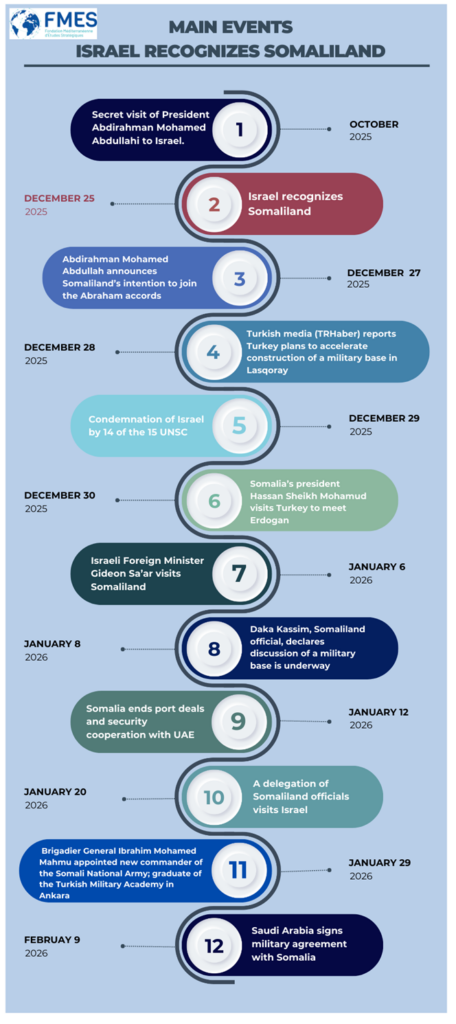
On January 28, 2026, Turkish National Security Council formally elevated Somalia to a strategic priority[27]. Simultaneously, the Turkish National Assembly extended the mandate for Turkish naval forces operating in Somali waters, the Gulf of Aden and Arabian sea for one year[28]. Brigadier General Ibrahim Mohamed Mahmud, a Turkish Military Academy graduate, was appointed Somali National Army Commander[29] . Whether by coincidence of the agenda or not, Turkey also deployed F-16 jets and helicopters to Mogadishu[30], as well as ASELSAN EIRS / ALP-300G radar system at the TURKSOM military base[31]. Besides, the Turkish media TRHaber reported on December 28, that Turkey was accelerating the construction of a new military base in Lasdoray district in the Sanaag region[32]. Whether it was long planned or a response to recent regional shifts, these actions clearly signal Turkey’s intent to consolidate its military presence in Somalia.
Adding another dimension, on February 9, 2026, Saudi Arabia signed a military agreement with Somalia for “regional stability and Red Sea security”[33]. Discussions were apparently also directed towards the establishment of a naval base in the port city of Lasqoray. This raises the possibility of a triangular partnership, with Somalia as the operational hub, Turkey providing advanced military capacity and infrastructure, and Saudi Arabia offering regional political legitimacy and security support. Such cooperation appears increasingly likely given the recent improvement in Turkey-Saudi Arabia relations. More broadly, it reflects Riyadh’s willingness to support Somalia amid ongoing uncertainties and to position itself quickly as a balancing partner. Taken together, the Turkey–Somalia alignment, and the potential broader Turkey–Saudi Arabia–Somalia nexus, appear to function as a direct counterweight to the UAE–Somaliland–Israel configuration centered on Berbera. In the words of Erdogan, “Israel tries to drag the Horn of Africa into chaos and instability”[34].
Israel-UAE-Ethiopia-Somaliland network
At the same time, Israel’s recognition of Somaliland must be seen within the complementary strategic framework emerging between the UAE, Israel and Ethiopia. This alignment is driven by a shared perception of threats from the Houthis, Iranian influence and Turkey’s growing presence in the region. The political cohesion of the grouping is reinforced by the Abraham Accords relationship between Israel and the UAE, alongside Ethiopia’s search for alternative strategic partners amid tensions with Egypt over the Grand Ethiopian Renaissance Dam (GERD). In this context, Israel’s diplomatic recognition provides the political layer completing UAE’s capital investment and Ethiopia’s search for maritime access.
Somalia’s government reacted forcefully to this entangled network. On January 12, 2026, Mogadishu cancelled port agreements covering Berbera, Bosaso and Kismayo, as well as security and defence cooperation with the UAE. It cited “harmful actions” undermining national unity and sovereignty[35]. Defence Minister Ahmed Moallim Fiqi stated that the decision was based on evidence of Emirati practices violating Somalia’s sovereignty, independence, and political unity[36]. Shortly afterward, some evacuations were reported at Bosaso airbase with a surge of cargo aircraft movements[37].
However, no movements were reported at Berbera port or its associated facilities. Somalia’s capacity to enforce its decision remains indeed limited, as the federal authorities of Mogadishu lack authority and control over Berbera. Somaliland rejected the cancellation[38] and asserted its sovereign right to maintain international partnerships[39]. DP World, the operators of the port, confirmed that operations would continue. In practice, the UAE are likely to maintain a presence in Berbera regardless of federal objections, and Israel may also make use of the existing infrastructure for civilian and military purposes, including intelligence operations.
Ethiopia also occupies a central position in the Israel-UAE network. Israel maintains long-standing security relations with Ethiopia, including intelligence cooperation agreements and military training. An agreement was indeed signed in 2020 between the Mossad and Ethiopian National Intelligence and Security Service, which includes information exchange and capacity building[40]. In 2021, they collaborated to arrest 16 suspects in Addis Ababa planning attacks on UAE embassies in Ethiopia and Sudan[41]. Hadera Abera Admassu, Ethiopian minister of Foreign Affairs, visited Tel Aviv in January 2026 to meet Foreign Minister Gideon Sa’ar to “deepen ties”[42].
Israel’s recognition of Somaliland could significantly enhance Ethiopia’s strategic position in the Horn of Africa by strengthening its path to maritime access. Ethiopia is the world’s most populous landlocked country and has long sought alternatives to reliance on Djibouti and Chinese-operated ports. By recognising Somaliland’s international standing, Israel indirectly reinforces Addis Ababa’s negotiations with Hargeisa, giving Ethiopia greater leverage to secure long-term port agreements, infrastructure access, and logistical support along Somaliland’s coast. Ethiopia had already signed a memorandum of understanding with Somaliland in 2024 granting long-term maritime access[43]. Israel’s recognition adds political weight to Ethiopia’s maritime ambitions.
At the same time Ethiopia gains strategic depth, Israel enhances its own regional footprint strengthening its ability to counter Iranian influence. Ethiopia has long maintained diplomatic ties with Tehran, and in May 2025 the two countries signed a security and intelligence cooperation memorandum[44]. Iran has also been an important supplier of drones during the Tigray war. Like Israel, Iran views Ethiopia as a gateway to expanding its influence in the Horn of Africa. This creates a layered strategic competition, with Israel positioning itself as a counterweight to Iranian influence, while Iran seeks to challenge the expanding UAE-Israel presence in the region. Ethiopia, positioned at the center of this rivalry, seeks to maximize its strategic gains without signalling preference for either side. Israel’s deepening security ties with Somaliland could further intensify this rivalry as both powers compete for regional dominance.
Egypt and China’s concerns
Egypt perceives the Israel-Somaliland-Ethiopia alignment as a potential “strategic encirclement”. For Cairo, the Suez Canal is not just revenue but a matter of national survival. The emergence of a competitor axis on the Red Sea southern flank, coupled with the ongoing pressure from Ethiopia’s Grand Ethiopian Renaissance Dam (GERD), adds pressure to Egypt’s security priorities. Although Israeli recognition of Somaliland does not, in itself, constitute a direct threat to Egyptian security, Cairo fears that Israel could use Somaliland as an entry point to expand its influence in the Horn of Africa and challenge Egypt’s strategic position. Egyptian President Al-Sisi met his Somali counterpart on February 8, 2026 and declared that “Egypt will always remain a sincere partner and a steadfast supporter of Somalia”[45]. Following the meeting, Cairo deployed some 1,000 additional troops to Mogadishu as part of the African Union Support and Stabilization Mission in Somalia[46]. It is particularly significant considering that until now, Egypt had primarily sent military equipment and very rarely troops.
What is particularly notable is that the Somalia file is reportedly under the supervision of Major General Ahmed Abdel Khalek, the official responsible for the Palestinian portfolio within Egypt’s General Intelligence Service. According to Al Araby, he conducted a series of secret visits across Africa in January, including Rwanda, Uganda, Libya, Eritrea, Somalia and Sudan[47]. This diplomatic activity suggests a preventive strategy aimed at countering Israel’s growing presence and influence in a region considered as Egypt’s backyard. As Israel potentially expands its diplomatic engagement and on-the-ground presence following recognition, the risk of increased regional competition and tension with Egypt correspondingly rises. At the same time, however, it is important to recognize that Israel has a strong incentive to maintain a cooperative relationship with Cairo, given Egypt’s role in managing the Gaza situation and, more broadly, in counterbalancing Turkish and Qatari influence over the Palestinian issue. This dual dynamic means that while competition may rise in the Horn, strategic cooperation with Egypt remains a priority for Israel.
China, concerned about its interests in Djibouti and the Horn of Africa, has also reacted to Israel’s recognition of Somaliland. This move challenges Djibouti’s role as a key regional hub and heightens Beijing’s unease due to Somaliland’s growing engagement with Taiwan. The two sides established mutual representative offices in 2020 and have since expanded cooperation. On July 24, 2025, they signed a coast guard cooperation agreement, opening a new phase of maritime collaboration[48]. China condemned these developments, framing Somaliland–Taiwan relations as a violation of the “One-China principle”.
Geostrategy adds another layer to China’s concern. Djibouti hosts China’s first overseas military base, a cornerstone of its maritime security architecture and a key node for protecting commercial routes connected to the Belt and Road Initiative. Recognition of Somaliland risks normalising Taiwan’s presence in a region where China has heavily invested in ports, telecommunications, and security partnerships. China’s reaction is driven less by the legal status of Somaliland than by a broader strategic calculus focused on preventing Taiwanese visibility and safeguarding Djibouti’s role as a primary regional hub.
At the same time, India’s expanding footprint in the region adds another dimension to the strategic calculus of Beijing. New Delhi has been strengthening economic, maritime, and security ties with countries along the Red Sea and the Horn of Africa to secure trade routes and counterbalance China’s dominance. The historic visit of Indian Prime Minister Narendra Modi to Addis Ababa on December 16, 2025[49], marked a new phase in India’s political anchoring in the region. Simultaneously, India has increased naval deployments in the Red Sea to protect maritime interests and counter piracy[50], while deepening defense, intelligence, and technological collaboration with Israel.
Conclusion: the path to further recognition?
Ultimately, recognising Somaliland is less about Somaliland’s independence itself than about who will shape the future order of the Red Sea corridor. The region is entering a phase in which peripheral territories acquire disproportionate weight in great power and regional rivalry. What was once episodic competition is hardening into structured contestation over security architecture and maritime dominance. It is a gradual rupture towards intensification of competitive geopolitics in the Horn of Africa.
Yet, further recognition remains uncertain. Ethiopia may be the most likely candidate given its urgent need for maritime access, but it must carefully balance strategic gains against the risk of escalation with Mogadishu and regional instability. The United Arab Emirates, despite its deep economic presence in Berbera, has so far preferred strategic ambiguity over formal diplomatic recognition. The United States may also favor enhanced cooperation without official recognition. President Trump, despite recognising Israel’s right to recognise Somaliland, opposed recognition and stressed “there has been no change in American One Somalia policy”[51]. In the case of the US, counterterrorism cooperation with Somalia remains central and formal recognition could jeopardize efforts to increase cooperation with Turkey.
The most probable scenario is sustained calibrated ambiguity. The United States continues to uphold “One Somalia,” prioritizing counterterrorism with Somalia and strategic ties with Turkey. Ethiopia maintains strategic balancing, and the UAE operates the Berbera port without formal diplomatic endorsement. A less likely scenario envisions Ethiopia formally recognising Somaliland to secure its 2024 Memorandum of Understanding for port access amid escalating Houthi disruptions. In this case, US alignment remains uncertain.
It seems that stability in the Horn of Africa and Somalia’s sovereignty outweigh the symbolic and strategic advantages of recognition. The near-term future of the territory is unlikely to hinge on a cascade of recognitions, but rather on a prolonged phase of calibrated ambiguity, where influence, access, and security cooperation matter more than formal sovereignty.
| Israel | Iran | Turkey | United Arab Emirates | Saudi Arabia | |
| Somalia | X | X | 2017: Turkey opens TURKSOM base. 2024: Defence and Economic agreement. | 2024: Military cooperation agreement. January 2026: End of military cooperation | February 2026: Military cooperation agreement. |
| Somaliland | X | X | X | 2016: Agreement to set up a military base in the port of Berbera. | X |
| Ethiopia | 2020: Israel’s Mossad and Ethiopia’s National Intelligence Services Agency agreed to cooperate in the areas of intelligence and security service. | 2025: Defence agreement signed to enhance their national police forces on intelligence sharing, cross border crime and security training. | 2021: Military agreement, which includes military training and education. | X | X |
| Eritrea | X | X | X | 2015: 30-year lease agreement for military use of port of Assab. | X |
Recent security partnerships in the Horn of Africa
[1] “PM Netanyahu’s Speech at the ECOWAS Africa-Israel Summit in Liberia”, Prime Minister’s Office, 2017
[2] Herb Keinon, “During historic Netanyahu visit, Kenyan president says Africa needs Israel”, The Jerusalem Post, 2016
[3]“PM Netanyahu Meets with Israel’s Ambassadors to African Countries”, Prime Minister’s Office, 2017
[4] “PM Netanyahu’s remarks at the start of the government meeting”, Government Press Office, 2026
[5] Lokman Abdullah, “Somaliland and the Israel-UAE Project in the Red Sea”, Al- Akhbar, December 2025
[6] Ragip Soylu, “Israel-Turkey rivalry moves to the Horn of Africa”, Middle East Eye, December 2025
[7] “Houthis Provide Somali Pirates with Advanced Tech”, Eurasia review, January 2026
[8] Voir le rapport des Nations Unies publié le 6 février 2025
[9] Faisal Ali, “Houthis and Al-Shabaab have a ‘functional strategic partnership’ Hussein Sheikh-Ali”, Geeska, Février 2026
[10] “The strategic nexus between Al-Shabaab and the Houthis and its implications for the region and global security”, Saldhig Institute, Février 2026
[11] Daniel Tester, “Red Sea Crisis: What do Israel and the UAE want from Somaliland?”, Middle East Eye, Février 2026
[12] Abdirashid Diriye Kalmoy, “Reasons behind Netanyahu’s Somaliland recognition”, Daily Sabah, Decembre 2025
[13] @Cadbiraxmaan Cirro, “This is a historic moment as we warmly welcome @netanyahu the Prime Minister of the State of Israel’s recognition of the Republic of Somaliland and affirm Somaliland’s readiness to join the Abraham Accords”, X, December 2025
[14] “Somaliland Leverages Israel Recognition to Court Washington and Global Powers”, Somaliland Post, Février 2026
[15] « Pour obtenir le soutien des Etats-Unis, le Somaliland propose ses minerais et des bases militaires », France 24, Février 2026
[16] “The Federal Republic of Somalia reaffirms its absolute and non-negotiable commitment to its sovereignty”, Press Statement, Ministry of Foreign Affairs, December 2025
[17] Caolan Magee, “Turkey’s Erdogan calls Israel Somaliland recognition ‘unacceptable’”, Al Jazeera, December 2025
[18] Ibid.
[19] “Communique of the 1324th meeting of the PSC held on January 2026”, Communiqué, African Union, January 2026
[20] “Joint statement by 21 Arab, Islamic, and African nations stressing their unequivocal rejection of Israel’s recognition of the Somaliland region”, Ministry of Foreign Affairs of Qatar, December 2025
[21] Faisal Ali, “Somalia cancels all agreements with UAE over alleged sovereignty violations”, Al Jazeera, January 2026
[22]Ameyu Etana, “Ambaasaaddarri Itoophiyaa waa’ee Somaalilaand, TPLF, Masrii maal jedhu?”, BBC News Afaan Oromoo, January 2026
[23] Syed Zafar Medhi , “Iran slams Israel’s recognition of Somaliland as ‘flagrant violation’ of Somalia’s sovereignty”, AA, December 2025
[24] Serdar Dincel and Merve Berker, “Israel’s decision to recognize Somaliland illegitimate, unacceptable: Turkish President Erdogan”, AA, December 2025
[25] “Turkish-trained special forces take Somalia back to days of civil war”, The Arab Weekly, February 2021
[26] “Turkey to provide maritime security support to Somalia- official”, Reuters, February 2024
[27] “Turkey declares Somalia unity a priority after Israel’s Somaliland recognition”, Al-Monitor, January 2026
[28] “Turkey Parliament extended naval deployment to Somali territorial waters”, Inside Somalia, January 2026
[29] Nuri Aden, “Somalia names news army chief to replace General Rage in major reshuffle”, TRT Afrika, January 2026
[30] Ragip Soylu and Bashir Mohamed Caato, “Turkey deploys F-16 jets to Somalia as it strengthens economic ties”, Middle East Eye, January 2026
[31] @Bashir Hashi Yussuf, “The Turkish military has deployed ASELSAN EIRS / ALP-300G radar system to Somalia at the TURKSOM military base”, X, January 2026
[32] @TRHaber, “Türkiye, Lasgari’de askeri üs inşaatını hızlandırıyor”, X, December 2025
[33] “Somalia, Saudi Arabia sign agreement on military cooperation”, Al Jazeera, February 2026
[34] “The preservation of Somalia’s unity and integrity under any circumstances is a priority for us”, Presidency of the Republic of Turkey, December 2025
[35] “Somalia ends port deals and security cooperation with UAE”, Reuters, January 2026
[36] @AhmedMoFiqi, “يأتي هذا القرار بناءً على تقارير وأدلة موثوقة تشير إلى ممارسات مرتبطة بدولة الإمارات العربية المتحدة تقوّض سيادة جمهورية الصومال ووحدتها الوطنية واستقلالها السياسي، وتشكل انتهاكًا واضحًا لمبادئ السيادة واحترام استقلال الدول وعدم التدخل في شؤونها الداخلية », X, January 2026
[37]Bashir Mohamed Caata, “UAE removing its military from Bosaso after angry Somalia ends agreement”, Middle East Eye, January 2026
[38]@somalilandmfa, “The Government of the Republic of Somaliland categorically rejects Somalia’s false claims over Berbera”, X, January 2026
[39] “Dubai’s DP World says operations at Somaliland’s Berbera port unaffected by UAE-Somalia dispute”, Reuters, January 2026
[40] “Ethiopia, Israel Agreed to Cooperate in Field of Intelligence, Security”, ENA Reliable News Source, November 2026
[41] Dina Lamloum, “Israeli military bases in the horn of Africa: Strategy of influence and redrawing power balances in the Red Sea”, SHAF Center, June 2025
[42] Zein Khalil and Rania Abushamala, “Israel calls Ethiopia ‘long-term strategic partner’, seeks to deepen ties”, AA, January 2026
[43] Kalkidan Yibeltal, “Ethiopia signs agreement with Somaliland paving way to sea access”, BBC News, January 2024
[44] “Iran expands African footprint as it seals security deal with Ethiopia”, Iran International, May 2025
[45] “President El-Sisi’s speech at Joint Press Conference with Somali President Hassan Sheikh Mohamud”, The Arab Republic of Egypt Presidency, February 2026
[46] “Egyptian troops take part in training ahead of AU deployment in Somalia”, Africanews, February 2026
[47] “تحركات مصرية في دول أفريقية لحصار نشاط استخباري إسرائيلي,”, Arab Reports, February 2026
[48] “Somaliland and Taiwan sign Coast Guard Cooperation Agreement”, The Republic of Somaliland Representative office in the Republic of China, August 2025
[49] « Ethiopie: le Premier ministre indien Narendra Modi en visite d’Etat à Addis-Abeba », RFI, Décembre 2025
[50] “40 warships deployed in Red Sea to counter threats, protect cargo: Navy chief”, India Today, December 2025
[51] “US defends Israel’s right to recognize Somaliland”, Le Monde, December 2025